
JADE – A BRIDGE BETWEEN CULTURES, ACROSS TIME
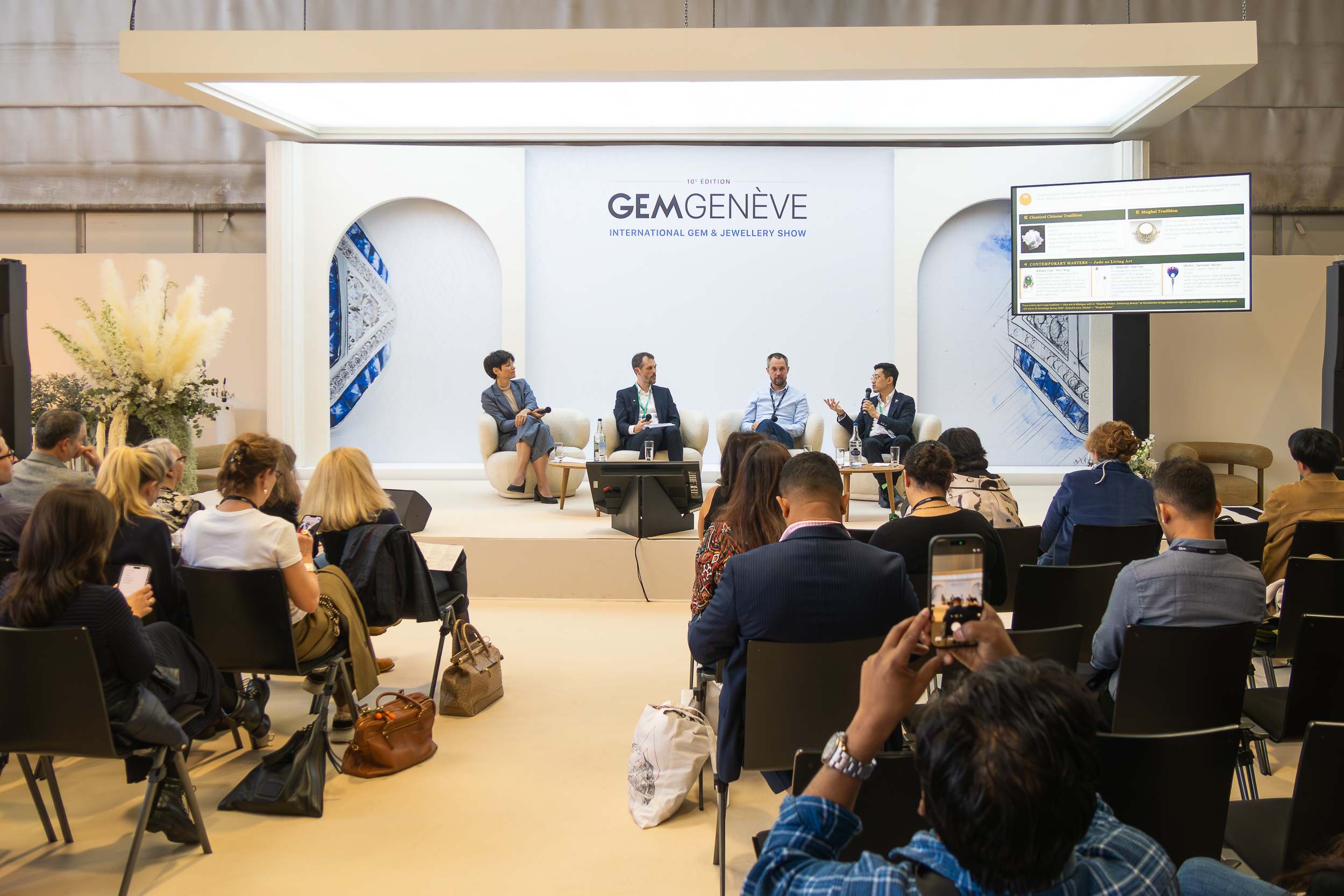
At GemGenève, a conversation spanning archaeology, imperial courts, museums and the contemporary market revealed how jade has endured by continually acquiring new meanings.
A jade cup can hold far more than its visible form. The vessel discussed during Jade — A Bridge Between Cultures, Across Time, a round table held at the tenth edition of GemGenève, carried within it the traces of Timurid inheritance, Mughal craftsmanship, Central Asian trade and Qing imperial collecting. Its journey offered an ideal point of departure for a wider question: what happens to a material when it crosses cultures, and how does its value change along the way?
Moderated by Laurent Cartier, the conversation brought together Jean-Baptiste Clais, curator in the Department of Decorative Arts at the Musée du Louvre; Pauline d’Abrigeon, curator of the Chinese collections at the Fondation Baur; and Wenhao Yu, co-founder of the Peron Group and former Chairman of Jewellery and Watches Asia at Sotheby’s. Their perspectives moved between museums, historical research, gemmology and the market, reflecting the many worlds that jade has inhabited.
A material in motion
The opening object, probably carved in a Mughal workshop during the seventeenth or eighteenth century, had reached the Chinese imperial court by the late eighteenth century. Clais used its trajectory to reconstruct a much broader geography of jade.
For centuries, Khotan in Central Asia was one of the principal sources of the nephrite used across China, the Timurid world and Mughal India. Knowledge, stones and objects travelled through diplomatic exchanges, religious networks and commercial routes. When jade carving developed at the Mughal court, it drew on Timurid precedents while gradually forming its own language of delicately carved vessels, floral ornament and thin, translucent surfaces. That language would later fascinate the Qianlong court in China, where Mughal objects were collected, inscribed and imitated.
The cup therefore resisted any simple attribution to a single cultural world. Its material originated in one place, its form was shaped in another, and its meaning was rewritten when it entered a new imperial collection. Jade emerges here as evidence of movement: of people, techniques, objects and ideas.
This circulation also complicates familiar divisions between East and West. Mughal jade was itself the result of earlier contacts between Central Asia, Persia and India. European lapidaries and jewellers later introduced tools and techniques at the Mughal court, adding another layer to an already cosmopolitan production. Artistic traditions rarely develop in isolation; the history of jade makes their interdependence unusually visible.
Before jade became a gem
Although much of the discussion focused on the last five centuries, the cultural history of jade reaches considerably further back. Archaeological finds in northeastern China attest to its ritual use in Neolithic cultures several millennia ago. A bi disc displayed at the entrance to the accompanying GemGenève exhibition recalled this extraordinary chronological depth, evoking jade’s early association with burial, ceremony and the relationship between the human and spiritual worlds.
Laurent Cartier also drew attention to prehistoric jade working in Europe, including the production and circulation of Alpine jade axes. Long before the material entered jewellery collections or auction catalogues, it served communities as a ceremonial substance, a marker of status and a material endowed with powers extending beyond ornament.
Its durability contributed to this status, though physical resilience alone cannot explain its cultural force. In China, jade became associated with ethical and social qualities. Classical texts compared its characteristics with the virtues of the cultivated individual: refinement, strength, integrity and restraint. Wenhao Yu illustrated the intimacy of this relationship through the Chinese characters for king and jade, distinguished by the addition of a single stroke. In his reading, jade was conceived less as a passive possession than as a companion capable of reflecting and cultivating noble conduct.
Clais nevertheless cautioned against treating this Confucian interpretation as an unchanging explanation for every period of Chinese history. Access to jade fluctuated, political and religious priorities evolved, and the meanings attached to the material changed from one dynasty to another. The frequent repetition of a celebrated ancient source can conceal centuries of historical variation.
That observation became central to the discussion: jade’s continuity does not depend on a single uninterrupted meaning. Its power lies in the range of meanings that successive societies have given it.
Changing measures of quality
For the contemporary market, Wenhao Yu identified three principal criteria in assessing fine jadeite: colour, texture and translucency. The most highly prized green jadeite combines vivid colour with a fine, tightly interlocked structure and sufficient translucency to allow light to enter the stone, producing the luminous effect for which exceptional material is admired.
Unlike faceted gemstones, jadeite is generally shaped into cabochons, beads or carved forms that reveal the character of the material rather than dispersing light through facets. Imperial green remains the best-known commercial ideal, although collectors now show growing interest in lavender, black and near-colourless jadeite as well. SSEF describes jadeite jade as a rock composed primarily of densely interlocked microscopic crystals, often accompanied by other minerals—a structural complexity that contributes both to its toughness and to the challenges of analysis and nomenclature.
The Hutton-Mdivani necklace provided the most famous market example mentioned during the panel. Composed of twenty-seven graduated jadeite beads and fitted with an Art Deco clasp by Cartier, it sold at Sotheby’s Hong Kong in 2014 for US$27.4 million, establishing a record for jadeite jewellery. Its matching colour and exceptional translucency illustrate the degree of consistency demanded at the highest end of the market.
Historical objects require a different framework. When Laurent Cartier asked what constituted exceptional jade at the Mughal court, Clais gave a revealing answer: the surviving evidence remains too limited to establish a reliable period theory of quality.
Only a small number of Mughal and Mughal-style jade objects bear inscriptions that allow them to be securely dated. Among the surviving works are stones of extraordinary purity alongside mottled, flawed or visually uneven material carved with exceptional skill. Artisans might exploit a coloured inclusion to form the mane of a horse, adapt a composition to the natural pattern of the stone or use decoration to disguise a fracture.
The historical significance of an object may therefore reside in the carving, its dynastic associations or its place within a courtly culture, independently of whether its raw material would satisfy contemporary gemmological ideals.
This distinction has profound implications for the way jade is valued. “Quality” is shaped by context. Modern market criteria privilege measurable visual and structural properties; the historian must attempt to reconstruct what a particular society admired, used or understood. Applying today’s hierarchy retrospectively risks overlooking the qualities that originally made an object meaningful.
When science changes the name
The word jade itself contains a further complication. It is commonly used for two different materials: nephrite and jadeite.
Nephrite dominated much of jade’s early history in China and Central Asia. Jadeite from present-day Myanmar entered Chinese imperial production on a significant scale much later, particularly during the Qing period. The brilliant emerald-like green now closely associated with the highest category of jade consequently represents only one chapter in a far longer and more varied history.
Modern gemmology distinguishes materials according to their mineralogical composition. Earlier cultures relied on sight, weight, polish, touch and perceived behaviour. A stone that imitated the colour and tactile qualities of jade might fulfil the same ritual or decorative purpose even when it would not now be classified as nephrite or jadeite.
Clais questioned whether such an object should automatically be described as “fake”. The term imposes a modern scientific category on a society that organised materials according to other criteria. For its original owner, a stone capable of reproducing the appearance, finish and symbolic function of jade may have been entirely successful.
Mineralogical authenticity and historical authenticity do not always coincide. Scientific analysis can tell us what an object is made of; it cannot, by itself, explain what that material meant to the people who used it.
The uncertainties of imperial jade
Similar caution applies to imperial attribution. An engraved reign mark may appear conclusive, yet Chinese workshops sometimes employed the marks of earlier emperors as acts of homage rather than deception. Conversely, an object without an imperial mark may still have been produced in a palace workshop.
Pauline d’Abrigeon explained that attribution depends on a combination of factors: the stone, the refinement of the carving and polishing, the absence of tool marks, the decorative language and the historical plausibility of the material. One deep-green vessel bearing a Qianlong mark, for example, was believed to have been made after the emperor’s lifetime because that particular material only became available at a later date. Another object, lacking any reign mark, could nevertheless be attributed to an imperial workshop on the basis of its workmanship and stone.
Clais added another layer of complexity. After the Qing conquest of the Khotan region in 1759, the volume of jade entering the imperial system increased dramatically. The court introduced classifications through which the finest stones were retained for the palace workshops while lower grades could be sold to commercial carving centres such as Suzhou. Archival evidence of smuggling, however, shows how quickly any apparently orderly system could be disrupted.
For museums, auction houses and collectors, certainty is assembled from multiple forms of evidence. Marks, style, archives, material analysis and provenance must be considered together, while allowing room for unresolved questions.
The collector’s eye
The jade collection assembled by Alfred Baur in the first half of the twentieth century offered another example of meaning being transformed through ownership.
According to Pauline d’Abrigeon, Baur was particularly attracted to late Qing jade, varied colours, translucency, technical refinement and excellent condition. His choices suggest an intense appreciation of material and craftsmanship, rather than a primary interest in the original ritual or philosophical meanings of the objects.
The same sensibility can be traced throughout his Chinese collection. Ceramics, snuff bottles and jades reveal a preference for polished surfaces, subtle textures, fine workmanship and objects small enough to be held and examined closely. The Fondation Baur’s participation in GemGenève, where it exhibited nearly forty works as part of the wider presentation Shaping Matter, Enhancing Beauty, extended this enquiry into the relationship between the artisan’s hand and the substance being shaped.
When a Chinese jade enters a European collection, its previous meanings do not simply disappear. They are joined by another history: that of connoisseurship, acquisition, display and the collector’s personal response to matter.
Understanding through touch
Touch became one of the most compelling themes of the panel.
Wenhao Yu encouraged the audience to handle jade whenever possible, describing the stone almost as a partner in a conversation. Weight, temperature, texture and translucency can reveal qualities that are difficult to communicate through photography. Familiarity develops through repeated contact, allowing the eye and hand to recognise distinctions that words struggle to express.
D’Abrigeon described a parallel experience within museum practice. Preparing condition reports may sound administrative, yet it offers the curator a rare opportunity to hold an object and perceive the qualities that once attracted its collector. The closeness of that encounter creates a form of knowledge unavailable to the visitor looking through glass.
Museums face an evident contradiction. Jade is a profoundly tactile material, while conservation demands physical separation. Clais acknowledged that permanent displays rarely have sufficient space to communicate the full complexity of an object’s geographical and cultural journeys. Temporary exhibitions offer greater possibilities: extended narratives, comparative displays, samples and practical activities can create a more embodied understanding without exposing ancient works to damage.
His point extended beyond jade. When visitors can engage with a material or process, the experience leaves a stronger memory. A museum becomes a bridge most effectively when it provides different ways of encountering knowledge rather than relying solely on visual contemplation.
A history that continues
The final part of the conversation turned towards contemporary carving and jewellery. Traditional centres remain active in China, where artisans train from a young age and the most accomplished can receive national recognition. Contemporary creators are combining jadeite and nephrite with titanium, diamonds and modern metalwork, adapting familiar forms such as beads, cabochons and carved plaques to a new visual language.
These works do more than preserve inherited techniques. They continue the process that has defined jade throughout its history: transmission through transformation.
A Mughal vessel entering a Qing collection, a Chinese object acquiring a new identity in Geneva, or a traditional carving incorporated into contemporary jewellery all demonstrate the same capacity for renewal. Jade crosses boundaries without remaining unchanged. Each encounter adds another interpretation, another system of value and another chapter to its biography.
The enduring power of jade lies in this extraordinary receptiveness. Across different periods it has embodied ritual authority, ethical virtue, dynastic legitimacy, protection, healing, technical mastery, aesthetic refinement and financial value. Some meanings have faded; others remain alive. In several Asian cultures, jade is still worn as a protective companion and as a link between the individual and a wider spiritual order.
The question raised by the GemGenève conversation therefore extends beyond how jade should be classified or priced. What do we truly acquire when we acquire jade: a material, a gemmological quality, a provenance or a history?
Perhaps the answer is found in the coexistence of all four. Jade has endured because it can carry them together, absorbing the values of each culture it encounters while retaining the physical presence that first invited the human hand to shape it.
Fonti principali: trascrizione integrale della talk fornita da GemGenève; programma e presentazione ufficiali di GemGenève e Fondation Baur; documentazione gemmologica SSEF.
Our thanks to:
Laurent Cartier, Head of Special Initiatives, SSEF
Jean-Baptiste Clais, Curator of the Asian Collections, Department of Decorative Arts – Musée du Louvre
Pauline d’Abrigeon, Curator of the Chinese Collections at the Fondation Baur, Museum of Far Eastern Art, Geneva
Wenhao Yu, Co-Founder of Paraqon Group