
GemGenève unveils its eighth temporary exhibition
Shaping matter, enhancing beauty

‘Shaping matter, enhancing beauty’ takes visitors on a deep dive into the world of rare materials.
Lapidary sculptor and master craftsman Hervé Obligi will be at GemGenève to celebrate the tenth edition of the show.
GemGenève’s cultural and educational ethos contributes to the event’s legitimacy, identity and longevity.
In a world where everything moves fast, creating meaningful spaces where knowledge can be passed on is a real responsibility.
Mathieu Dekeukelaire, Director, GemGenève
For its eighth on-site exhibition from 7 to 10 May this year, GemGenève has come up with an innovative offering that explores the very essence of artistic creation – the powerful and fragile instant at which the human hand and raw materials interact. Shaping matter, enhancing beauty offers insights into handicrafts, celebrating the transitioning of material from its raw state into precious artefacts.
Download the exhibition catalog
>>THE HUMAN TOUCH AT THE HEART OF THE LATEST EXHIBITION
SHAPING MATTER, ENHANCING BEAUTY
From cutting and polishing to engraving and carving, a crucial encounter lies behind every jewel and objet d’art at the point where the artisan’s hand meets the material itself. This original GemGenève exhibition sheds light on the unspoken dialogue between mineral and organic matter and the hand that shapes it.
Every single gesture is not only technically precise: it is also a decisive stage in the birth of an item of jewellery or work of art. Combining technique, tradition, experience and intuition, this dexterity embodies knowhow that is hard to put into words – but no less praiseworthy for all that.
Devised by Mathieu Dekeukelaire with the support of the Baur Foundation, the Museum of Far Eastern Art and the Geneva Museum of Art and History (MAH), the exhibition brings together over one hundred items loaned from institutional and private collections. Pauline d’Abrigeon and Estelle Fallet, curators at the Baur Foundation and MAH Geneva respectively, have pooled their expertise for GemGenève to co-curate its latest cultural event and make this ambitious project a reality.
From cameos to nephrite vases from the Qing dynasty via intaglio prints and Art Deco nécessaires, the exhibition offers a broad and eclectic overview of the extraordinary diversity of materials used in handicrafts through the ages. Featuring jade, horn, onyx, agate, coral and amber, Shaping matter, enhancing beauty offers a deep dive into the world of rare mineral and organic materials – most of the latter now covered by strict legislation due to their links with protected species.
Alongside the exhibition itself, Pauline d’Abrigeon will be sharing her knowledge and insights during a dedicated panel discussion, giving the general public an in-depth perspective on the works of art on display.
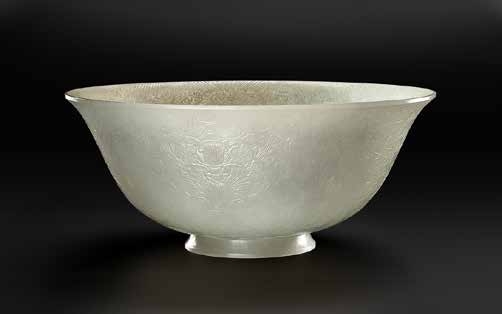
Bowl (one of a pair) with floral decorations, China Nephrite, Qing dynasty,
Qianlong imperial workshop 乾隆 (1736-1795), inventory no. CB-JC-1930-38,
courtesy of the Baur Foundation Museum of Far Eastern Art.
© Baur Foundation / Marian Gérard
>> THE BAUR FOUNDATION’S MUSEUM OF FAR EASTERN ART COMES TO GEMGENÈVE
FROM IMPERIAL JADE TO JASPER SNUFF BOXES, NEARLY TWO SCORE ITEMS
FROM THE MUSEUM FEATURE IN THIS OFF-SITE EXHIBITION
Our desire to promote the wealth of materials and decorative techniques for which our collection is renowned and reconnect with connoisseurs and friends of the museum naturally encouraged us to be present at GemGenève this year. At a time when the Baur Foundation’s premises are closed, this event in Geneva with a strong emphasis on exceptional craftsmanship offers a chance to display some of our works in a space that makes sense for us.
Laure Schwartz-Arenales, Baur Foundation director and general curator,
Museum of Far Eastern Art
The Baur Foundation’s Museum of Far Eastern Art has been closed for renovations since August 2025 – but is getting ready to write a new chapter in its history in just a few months’ time. Ahead of the museum’s reopening, GemGenève has invited the Foundation to come to Palexpo and stage an off-site exhibition – a unique opportunity to admire some of the finest pieces from its collection. Almost forty objets d’art belonging to the private foundation will be on show at Shaping matter, enhancing beauty – a fitting way to share the treasures of this Geneva institution with GemGenève visitors and exhibitors alike.
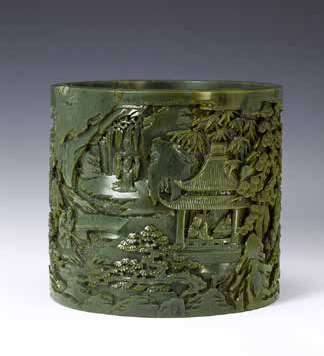
Brush jar, China: nephrite, Qing dynasty, 18th century,
Qianlong Imperial workshops 乾隆 (1736-1795),
inventory no.: CB-JC-1926-98, Courtesy of the
Baur Foundation Museum of Far Eastern Art
© Baur Foundation / Marian Gérard
Located in Geneva in a mansion dating from the late nineteenth century, the Baur Foundation is home to one of Europe’s most remarkable collections of Chinese and Japanese art. Jades, porcelain, lacquer furniture, engravings, netsuke and sabre decorations are among the nine thousand or so artefacts amassed by Swiss collector Alfred Baur (1865-1951), including one of Europe’s largest collections of Chinese porcelain – and some items produced by the Imperial manufactories.
Since 1995 the museum has also benefited from several gifts, in particular of antique Chinese lacquer furniture, Chinese export porcelain, Chinese and Japanese fabrics and a large collection focusing on the Japanese tea ceremony. The Baur Foundation is the only museum in Switzerland solely devoted to far eastern art and also hosts temporary exhibitions several times a year.
>> THREE QUESTIONS TO PAULINE D’ABRIGEON
CURATOR OF CHINESE COLLECTIONS, BAUR FOUNDATION AND EXHIBITION CURATOR
What materials were you keen to highlight and why?
Given the fact that gemstones are at the heart of this event, our thoughts went first to the Baur collection of jades – they make up the largest share of the loan, accounting for over half of the works on display.
Jades are also the inspiration for the exhibition’s title Shaping matter, enhancing beauty: jade is an exceptionally hard gemstone, calling for painstaking abrasion of the surface to allow decorations and distinctive shapes to emerge.
From this central theme we’ve extended our selection to include artefacts made using a variety of materials such as coral, ivory and agate, all highlighting the dialogue between the raw materials and human hands.
What are the most spectacular pieces you’ve chosen for display at GemGenève?
Shaping matter, enhancing beauty is an opportunity to present exceptional items produced in the Imperial workshops, revealing the tastes of Emperor Qianlong (who reigned from 1736 to 1795) for translucent white jades – and intellectual culture.
An especially fine bowl whose entire surface is decorated with floral patterns is a perfect example of the expertise of these workshops, as is a brush pot carved out of a single piece of jade whose decorations, akin to a painting, are an invitation to explore the garden of Chinese man of letters and calligrapher Wang Xizhi 王羲之, (321-379 or 303-361).
What were your criteria for selecting the jades that will be on show at GemGenève?
We chose pieces featuring a wide range of colours, allowing visitors to appreciate this material’s extraordinary diversity of hues, ranging from milky white to so-called ‘spinach’ jade recovered from the shores of Lake Baikal before being worked on in China.
>> AN EXHIBITION BUILT ON COLLABORATION
WITH COMMITTED CULTURAL PARTNERS AND COLLECTORS
The Shaping matter, enhancing beauty exhibition is the outworking of a collaborative dynamic that brings together leading cultural institutions and private collectors. Loans have come from the Baur Foundation, the Museum of Far Eastern Art, the Geneva Museum of Art and History, the Natural History Museum of Geneva, exhibitors Faerber Collection, Nicolas Torroni and Ernst Färber and others.
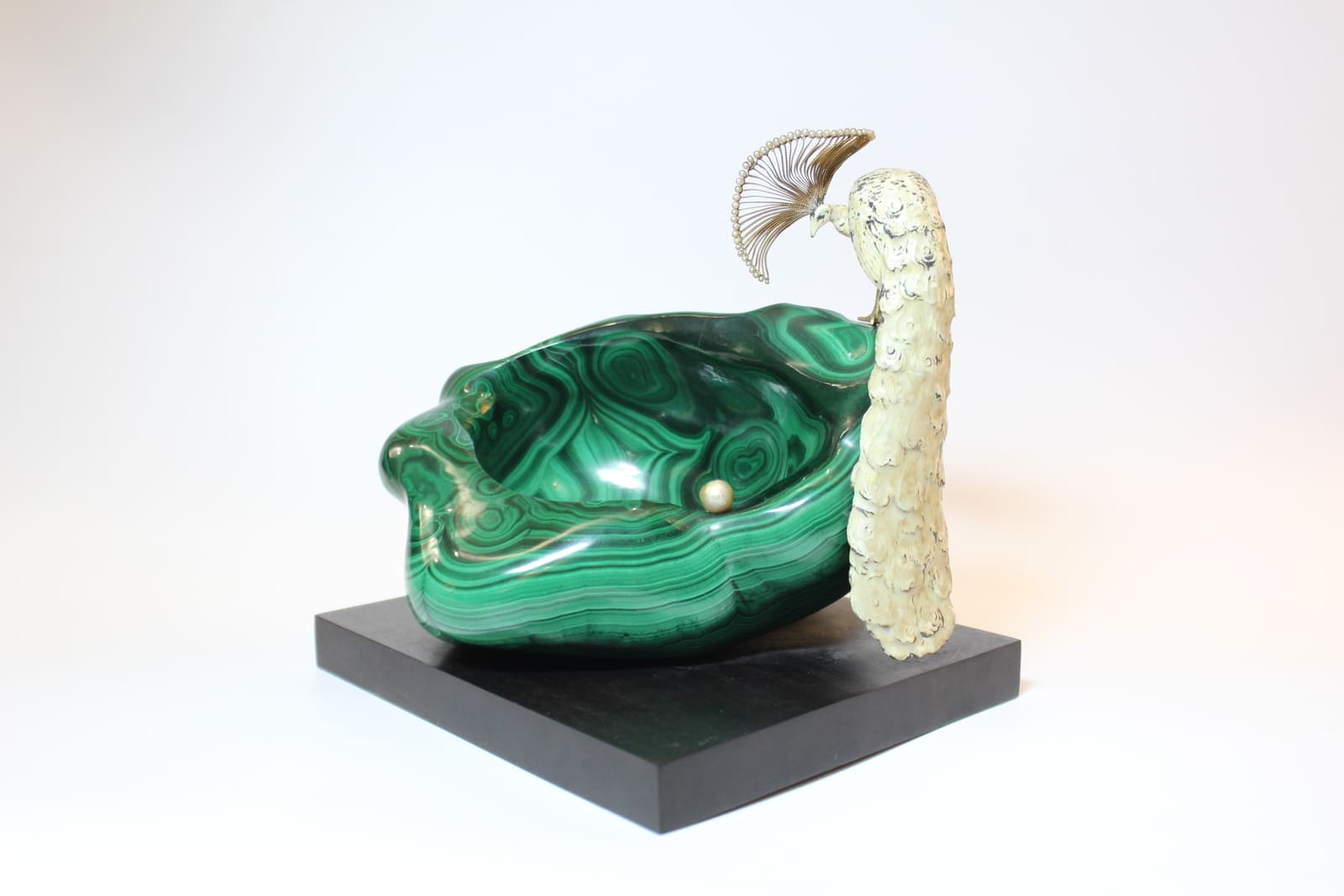
Alfredo Ravasco: malachite cup presented at the Venice Biennale in 1930;
peacock in enamelled silver, pearls and wood, with original display stand,
Courtesy of Nicolas Torroni © Nicolas Torroni
NICOLAS TORRONI
Bringing the Venice Biennale to GemGenève
Based in Geneva, Nicolas Torroni specialises in exceptional gemstones, pearls and antique pieces, as well as crafting his own jewellery. He will be exhibiting at GemGenève for the fifth consecutive year together with his two sons Alexandre and Constantin, and is also an exhibition partner.
Acclaimed in the world of jewellery as one of the rare specialists in the work of Milanese jewellers Alfredo Ravasco and Giacomo Ravasco, active in the previous century, Nicolas Torroni has agreed to loan several items from his personal collection – including a malachite cup first displayed at the 1930 edition of the Venice Biennale.
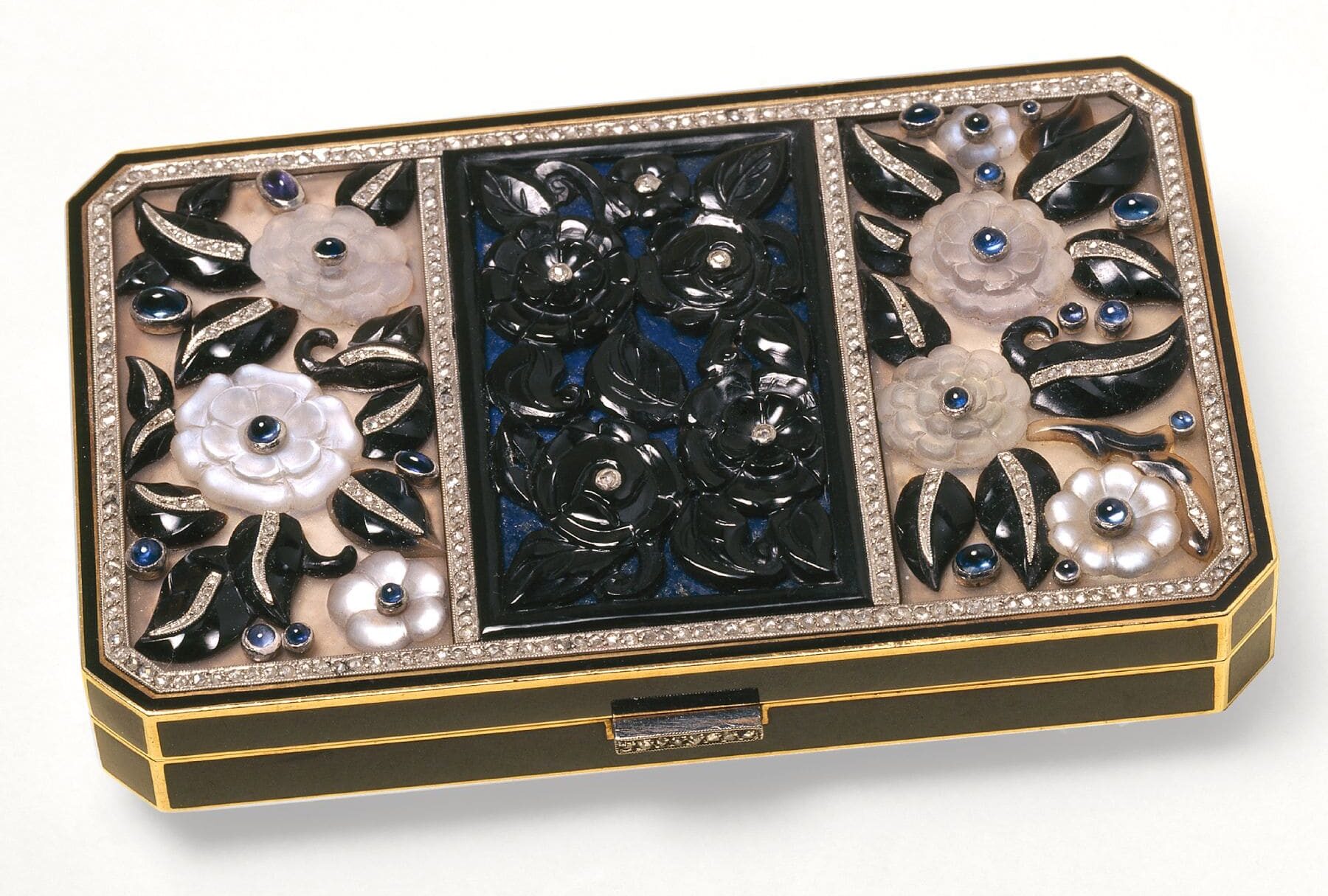
Art Deco vanity case, c.1925. 18K yellow gold with black lacquer decorated
with lapis lazuli applique, onyx flowers and diamond pistils. Lid and sides decorated
with engraved flowers in moonstone, onyx and rock crystal with cabochon sapphire
and diamond highlights. French work, maker’s mark: ‘Strauss, Allard, Meyer’.
Numbered. Courtesy of Faerber Collection
ESTELLE FALLET’S FAVOURITE THINGS
Curator at the Geneva Museum of Art and History and exhibition curator
The Geneva Museum of Art and History (MAH Genève) is a leading Swiss cultural institution and one of the largest museums in the country. The MAH has been a GemGenève partner since 2023 and is once again joining forces with the show founded by Ronny Totah and Thomas Faerber, displaying over a score of pieces from its collections.
Why did you choose this item in the MAH’s collection for the Shaping matter, enhancing beauty exhibition?
This ‘pocket necessaire’ holds ivory writing tablets and small personal grooming items, and is both utilitarian and a status symbol. Its material qualities and workmanship led to it entering Geneva’s public collection as a witness to the dexterity of the English goldsmiths who crafted these ‘miraculous’ jewelled containers.
It illustrates the production of necessaires in the shape of flat, bevelled cases that flourished between 1750 and 1760, most of which were made from hard gemstones: grey, blue, orange or pink agate or jasper. Their repoussé gold mountings engraved with rocaille motifs combining flower garlands and volutes showcase the ornamental grammar of the London workshops.
The piece was acquired by the Geneva Museum of Archaeology in 1909 and then moved to the Decorative Arts section of the Museum of Art and History in 1929.
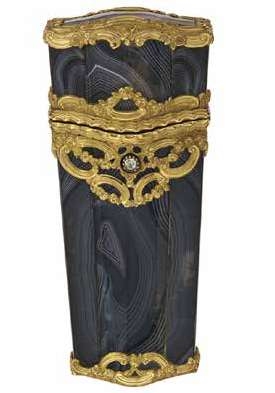
Necessaire case, England, 1750-1770.
Six-sided case containing a pair of scissors, a razor, a bodkin, tweezers, a nail file and a double-sided writing tablet. Repoussé, engraved yellow gold mountings, agate veneer on coloured render, hinged lid with push button decorated with a faceted natural green diamond (c.1600) set in a silver mounting; tortoiseshell razor with gold and silver inlays, silver blade, gold and silver accessories, gold riveted ivory panels. Height: 9.15cm, width: 4cm, thickness: 2.4cm, City of Geneva, Museum of Art and History. Inv. no. 5139. © MAH Genève
>>OPENING DOORS TO THE MÉTIERS D’ART
Certain age-old techniques still play a vital role in the worlds of arts and crafts and artisanal excellence, and so the exhibition does more than simply display: it also passes on knowledge. With two workshops featuring live demonstrations throughout the duration of the show Shaping matter, enhancing beauty offers a peek behind the scenes and the uniqueness of the craftsmanship. In all, over 130sqm of
space is devoted to the temporary exhibition.
Specialists in opal, tortoiseshell and ornamental gemstones will be revealing their expertise, offering visitors highly practical insights into materials and techniques alike, as well as a rare opportunity to meet master craftspeople from Switzerland, France and Germany – and watch them put these extraordinary techniques into practice.
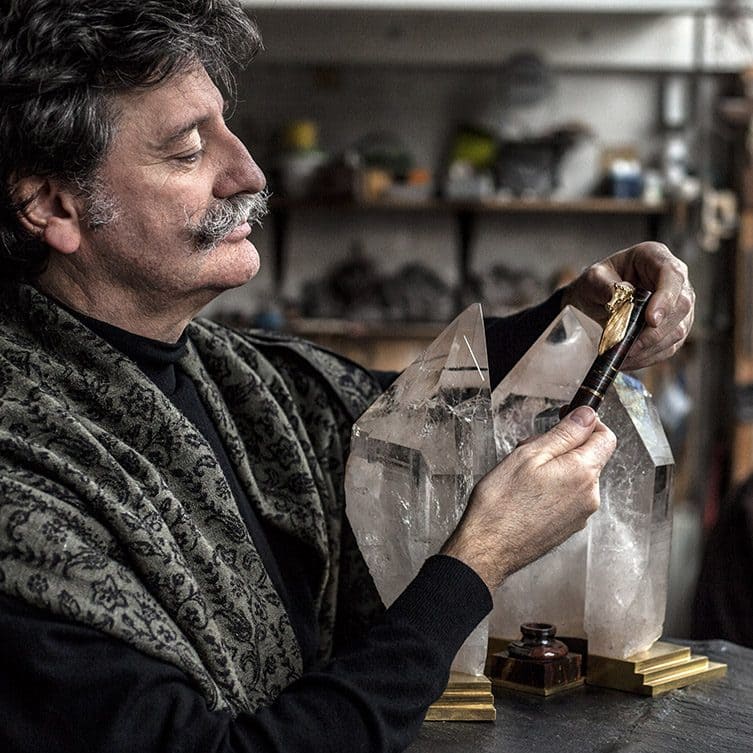
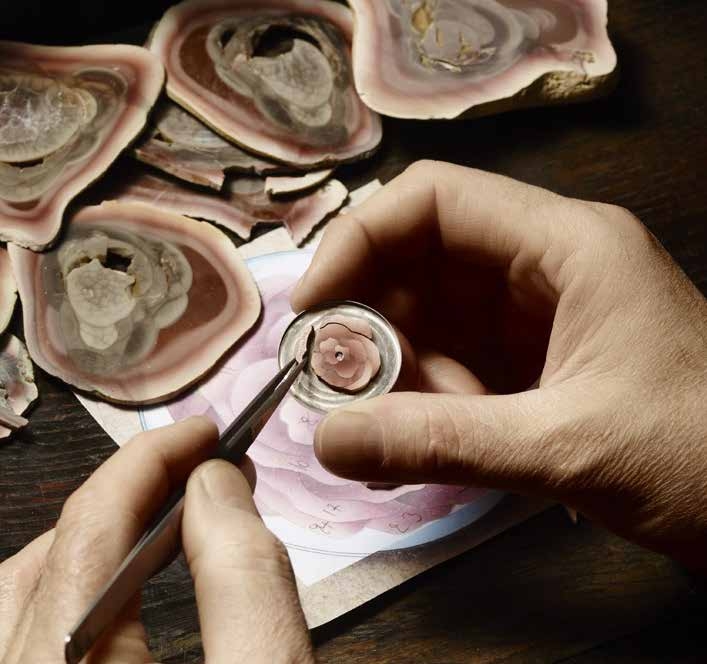
Lapidary sculptor and master craftsman Hervé Obligi
© Hervé Obligi
HERVÉ OBLIGI
Lapidary sculptor and master craftsman
Hervé Obligi has chosen to express his artistic talent through the medium of stone. From jewellery to watchmaking and from furniture to contemporary sculpture, the master craftsman has been putting his talents to work for prestigious institutions and fashion houses for over twenty years: his clients include Cartier, Piaget, the Château de Versailles, the Louvre and the Prince’s Palace of Monaco.
Awarded the Living Heritage Company distinction (Entreprise du Patrimoine Vivant, EPV) in 2010, Hervé Obligi works in his studio on the outskirts of Paris. He is represented by the Todd Merrill Studio gallery in New York and the Michèle Hayem gallery in Paris – and in a rare move, he will be setting up shop at Palexpo to share his passion and expertise with visitors to the tenth edition of GemGenève.
A specialist in hard stone marquetry
Hervé Obligi has been crafting and restoring various types of objets d’art since 1985: watch dials for Piaget, pavements for the Villa Fiorentina in Saint-Jean-Cap-Ferrat, writing implements madeas unique pieces and more. His career bears witness to a rare degree of expertise and constantly renewed artistic creativity.
Initially trained in wood sculpture, his interest in colour drew him to stone and led him to explore the infinite number of shades present in the world of minerals. Using aventurine, opal, obsidian, flint and more, his works sit at the crossroads between ancient and contemporary techniques, celebrating both the subtle art of marquetry and the raw beauty of minerals.
Sixty to eighty percent of my work is the restoration of Boulle and tortoiseshell marquetry.
I’ve specialised in this field because it’s my firm conviction that only regular, in-depth practice allow me to achieve the levels of quality and professionalism I require of myself.
Ulli Freyer
ULLI FREYER
Restorer specialising in tortoiseshell
Ulli Freyer specialises in Boulle marquetry, a technique that involves combining various types of wood, brass and tortoiseshell in complex decorative patterns. Freyer initially trained as a cabinetmaker in Germany before moving more into organic materials.
A renowned figure in the field of objet d’art restoration, his area of skill extends to all artisanal artefacts made from materials such as tortoiseshell, horn, baleen, ivory, bone and mother-of-pearl and various combinations of the former with brass, tin, silver, gold-plated silver and gold.
He has restored several works in the collections of the International Museum of Horology and the Basel Historical Museum – evidence of the trust placed in him by leading heritage institutions.
For the tenth edition of GemGenève, Ulli Freyer will be leaving his studio in Bern to reveal the hidden secrets of materials consisting of keratin (horn, tortoiseshell and baleen) – and share his exceptional knowhow with us.
À la carte guided visits
To allow journalists and content creators the best possible exhibition experience, GemGenève’s press department will be organising guided tours on request. Contact our press team as soon as you arrive at the event: they’ll arrange a 40-minute guided tour for you, accompanied by an art historian. This service is also open to the general public.
>> BEYOND THE EXHIBITION
IVORY: THE SECRETS OF WHITE GOLD
Get your signed copy!
After attending GemGenève in 2024 for the release of my book La représentation du bijou dans la peinture (‘Depictions of jewellery in art’), I’m delighted to be returning to the event – a key meeting-place that brings together excellence in all its forms, devoted to disseminating the knowledge held by professionals and passionate connoisseurs alike.
Brigitte Serre-Bourret, author of Ivoire, secrets de l’or blanc (‘Ivory: the secrets of white gold’)
From the Paleolithic to the nineteenth century, Brigitte Serre-Bourret’s latest work Ivoire, secrets de l’or blanc (Éditions des Falaises) retraces the fascinating history of this precious material derived from elephant tusks and the teeth of hippos, walruses, sperm whales and narwhals. It is the first general-interest book to address the topic in such breadth in over thirty years.
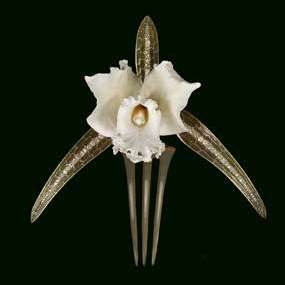
Brigitte Serre-Bourret, Ivoire, secrets de l’or blanc,
Éditions des Falaises, November 2025, illustration
from p.134: René Lalique, Orchid Comb: ivory,
gold, plique à jour enamel, horn, diamonds
© Walters Art Museum
As well as exploring how humans have sculpted, engraved and carved ivory over the centuries, the work draws readers’ attention to the gradual extinction of the species from which these treasures come. It also reveals some little-known facts: who knew that there’s such a thing as plant-based ivory? The author devotes several fascinating paragraphs to phytelephas, a palm tree native to Ecuador that is at the origin of a whole art craftingsmall artefacts.
From veneer saws to drilling via abrasion, the range of tools and techniques used by ivory craftspeople is also set out in loving detail, including the procedures used to replicate weathering aimed at altering the appearance or the perceived quality of the material.
Brigitte Serre-Bourret holds a PhD in art history and archaeology and is an honorary head curator of heritage; today, she is putting her museum expertise to good use in the realm of research and higher education.
TALKS AND PANEL DISCUSSIONS
Not-to-be-missed cultural events
The four days of the event will see several panel discussions and talks on topics including agate, jade and the enhancement of private collections. Museum curators and leading cultural figures will be among those taking part in this packed and fascinating schedule.
ASSOCIATION GEMMOLOGIE ET FRANCOPHONIE
Don’t miss this talk
The Gemmologie et Francophonie association (Association Gemmologie et Francophonie) is one of GemGenève’s longstanding partners, contributing its scientific approach at every edition of the event. Once again this year its gemmologists have enriched the exhibition by documenting the selected gemstones and creating the labels used for the displays.
To slake mineralogical connoisseurs’ curiosity, the association will be holding a panel discussion on Friday 8 May.
LETU BOOKS’ POP-UP BOOKSHOP IS BACK!
Discover a selection of books on topics relating to the exhibition
Founded in Geneva by Bernard Letu in 1973, Letu Books specialises in works covering applied arts.
Covering over four thousand years’ worth of jewellery creations, the bookshop has one of the broadest catalogues available for all styles and periods. To celebrate the tenth edition of GemGenève, this Geneva institution will be back with us in the form of a pop-up bookshop with a huge selection of books devoted to jewellery alongside works relating to the topic of the Shaping matter, enhancing beauty exhibition.
Enthusiasts, collectors and inquisitive readers keen to further their knowledge after the event won’twant to miss this stop at the show!
>> PROMOTING CULTURE AT GEMGENÈVE
MATHIEU DEKEUKELAIRE’S LASTING AMBITION
As Director of GemGenève since 2019, Mathieu Dekeukelaire works tirelessly behind the scenes to ensure the event retains its cultural and educational dimension. Amid exhibitions, cultural programming, projects and awards organised with partner schools and a special focus on Métiers d’Art, there’s a clear desire to shift the paradigm away from conventional tradeshows and open up a raft of new possibilities. We sat down with the man whose job is to get people together for a common cause.
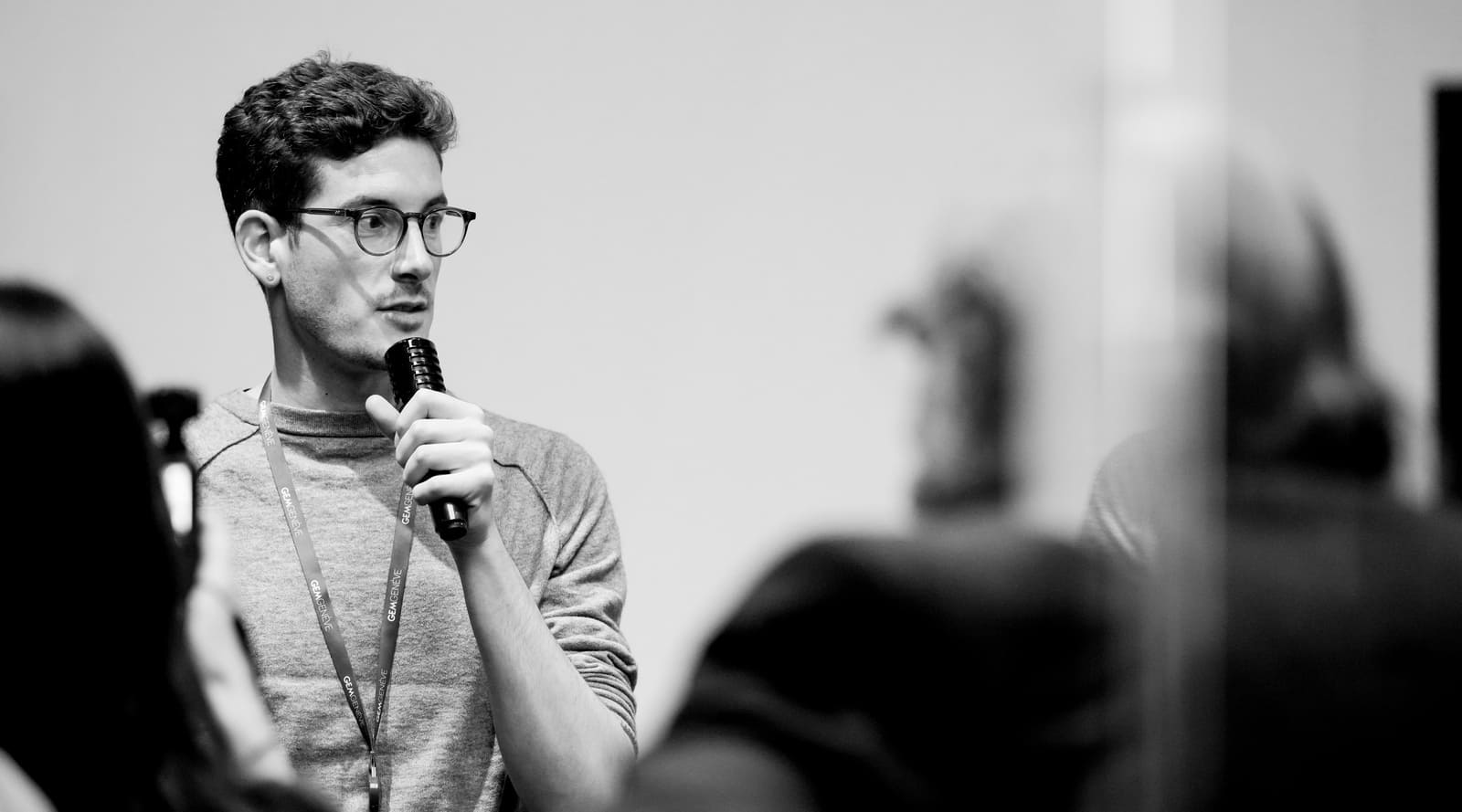
Mathieu Dekeukelaire presenting Art Deco: A Legacy of Timeless Elegance,
the seventh exhibition organised by GemGenève in May 2025 © David Fraga
Your career has been a mixture of management, law, contemporary art and events management. Isn’t that rather an odd combination for someone heading up GemGenève?
It may look that way, but it makes perfect sense for the person holding things together behind the scenes. I’ve brought strategic vision, legal acumen, professionalism and anticipation from my background in management. Organising an event like GemGenève is all about understanding the whole, structuring every detail and bringing together very different worlds: jewellers and cultural partners as well as technical, financial and security concerns. Jewellery resonates with my own
personal tastes, too: art, a love of beautiful things, passing on knowledge, and interacting with exceptional people. At the end of the day, my journey is very much in line with the GemGenève ethos: demanding standards, a methodical approach, and cultural openness.
Why have you sought to bring a cultural and educational dimension to GemGenève?
Probably because I’ve brought my own inquisitive nature and enthusiasm to learn more about this multifaceted world to the event! Opening up to the general public, supporting emerging talents and young designers, promoting student projects, talks and panel discussions are all very much in step with the values of GemGenève’s two founding families – and my own. Passing on expertise and knowledge is essential if we are to preserve creative skills in Europe. It’s vital to prepare a new generation of
connoisseurs and collectors too, and to address the desire to learn as much as we can from all the actors in this environment. You have to bear in mind that this is a world of passionate enthusiasts! The exhibitions we’ve produced provide context for the items displayed by dealers. The Métiers d’Art space is a fundamental part of the event where craftspeople embody excellence that often attracts much less attention than the big names. Putting them centre stage restores balance to the narrative.
What do you see as being your most important goal today?
The awards, competitions and partnerships with schools take up a key challenge: the next generation. If we want the industry to survive, we absolutely have to support young talent, encourage training and create practical ways to enter the market. The meetings with authors, talks and panel discussions all add an intellectual dimension, informing our thinking, documenting the related history and enriching our understanding of our heritage.
Behind each and every jewel and gemstone lies a story, a human hand, a technique, and a culture. Highlighting these aspects is a way of adding depth to the market.
As you can see, this cultural and educational ethos is far more than an add-on; it contributes to GemGenève’s legitimacy, identity and longevity. In a world where everything moves fast, creating meaningful spaces where knowledge can be passed on is a real responsibility.
Why are you so keen to put Geneva on the map?
Geneva is a magnificent pool of talent with its watchmaking heritage, its jewellery culture and its internationally acclaimed schools. In addition to the leading brands headquartered here, the city is also home to many private foundations (some of which are little-known to the general public) and museums whose collections deserve to be on display. When your event’s called GemGenève (which sounds the same as the French for ‘I love Geneva’) it’s only natural to be partnering with the city’s cultural and educational institutions. We’re very proud to be able to say that we’re working with the likes of the Grand Théâtre de Genève, the Geneva University of Art and Design (HEAD – Genève), the Geneva Vocational Training Centre for Arts & Crafts (CFP Arts Genève), the Geneva Museum of Art and History, and in 2026 with the Baur Foundation Museum of Far Eastern Art and the Natural History Museum of Geneva.
We’re also developing ties with international institutions, welcoming curators from the Louvre, working with the Boghossian Foundation, the Azzedine Alaïa Foundation and others, as well as exhibiting items from the heritage collections of leading jewellery houses on Place Vendôme in Paris.
>> ALL GEMGENÈVE’S EXHIBITIONS
FIND IT ON DIGITAL.GEMGENEVE.COM
Style | Art Deco: A Legacy of Timeless Elegance, May 2025
With an enthralling overview of one of the most creative periods in the twentieth century, the seventh on-site exhibition featured over two hundred items from the worlds of jewellery, furniture, watch and clockmaking, haute couture and arts and crafts, as well as documents and archives from the period in question. Exhibits included historic artefacts from the Geneva Museum of Art and History (MAH), the
International Museum of Horology (MIH) and the heritage collections of Chaumet, the Boghossian Foundation and the Azzedine Alaïa Foundation.
Materials | Flames of Opal Essence, May 2024
GemGenève 8 gave pride of place to one of the most fascinating precious stones: opal. Through a selection of some one hundred jewels and works of art, the exhibition explored the mysteries of this very special gemstone and its role in jewellery art through the ages, with items from Piaget, the MAH and exhibitors and designers present at the show.
Tradition | The Pearl Odyssey, November 2023
This poetic exhibition retraced the history of the grand tradition of pearls in European jewellery, bringing together over forty outstanding jewellery items including pieces from the Chaumet heritage collection and exhibitors such as Horovitz & Totah, Paul Fisher Inc., G. Torroni and the Swiss Gemmological Institute (SSEF) as well as a private loan from Oasis Pearl.
Métiers d’art | Automatons & Music: the magic of mechanical art, May 2023
Did mechanical art embody the renewal of exceptional jewellery? This was the question raised by the exhibition, which presented several important pieces from the collections of the Geneva Museum of Art and History, the International Museum of Horology and François Junod, one of the last fine automaton makers.
Jewelsmithing | Fabulous Carl Fabergé, November 2022
On the occasion of its fortieth anniversary, the Igor Carl Fabergé Foundation invited visitors to GemGenève to look back at the world of the most famous jeweller to the Russian Imperial Court. Bringing together over 120 items held in private collections, the retrospective highlighted the creativity and multi-talented skills of the Fabergé workshops in Saint Petersburg and Moscow.
History | Micro-mosaics through the ages, November 2022
Devoted to a technique dating back thousands of years, the exhibition sought to shed new light on a forgotten skill, featuring fragments of ancient mosaics from the Roman Museum in Avenches and antique jewels and pieces from the eighteenth and nineteenth centuries alongside contemporary work by artist Maurizio Fioravanti.
Knowhow | Enamel, the art of fire and colour, May 2022
The first exhibition was devoted to an age-old technique that established the reputation of workshops in Geneva and elsewhere, showcasing every type of enamel: cloisonné, champlevé, plique à jour and more besides.